Polyvagal Theory and the Window of Tolerance: Understanding Your Nervous System
Why Your Nervous System Matters for Emotional Health
Many people come to therapy feeling overwhelmed, shut down, anxious, or disconnected—often without fully understanding why. Polyvagal theory offers a compassionate, science-informed framework for understanding how the nervous system responds to stress, safety, and connection. When paired with the concept of the window of tolerance, this approach can help make sense of emotional reactions and support meaningful, lasting change.
At Garden City Center, we often integrate nervous system–informed concepts like polyvagal theory to help clients build awareness, self-compassion, and practical tools for regulation in everyday life.
What Is Polyvagal Theory?
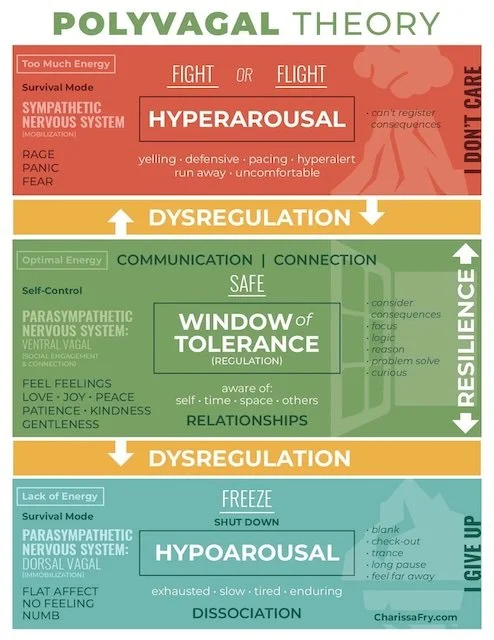
Polyvagal theory, developed by Dr. Stephen Porges, explains how the autonomic nervous system responds to cues of safety and threat. Rather than viewing the nervous system as simply “calm” or “stressed,” polyvagal theory describes three primary states that shape how we experience ourselves, others, and the world:
Ventral vagal (safety and connection): When the nervous system feels safe, we are more present, grounded, emotionally open, and able to connect with others.
Sympathetic (fight or flight): When the nervous system detects threat, we may feel anxious, restless, angry, overwhelmed, or hyper-alert.
Dorsal vagal (shutdown or collapse): When stress feels overwhelming or prolonged, the nervous system may shift into withdrawal, numbness, low energy, or disconnection.
These responses are not choices or character flaws—they are automatic survival responses shaped by past experiences, stress, and environment.
Understanding the Window of Tolerance
Featured Snippet: What Is the Window of Tolerance?
The window of tolerance is the range of emotional and nervous system activation in which a person can manage stress, think clearly, and stay emotionally present. When you are within your window of tolerance, you can feel emotions without becoming overwhelmed or shutting down, making it easier to cope with daily challenges and connect with others.
The window of tolerance refers to the range of nervous system activation in which we can think clearly, feel emotions without becoming overwhelmed, and stay connected to ourselves and others. When we are within our window of tolerance, daily stressors feel more manageable, and we are better able to respond rather than react.
When stress pushes us above our window, we may experience anxiety, panic, irritability, racing thoughts, or a sense of being out of control. When stress pulls us below our window, we may feel numb, disconnected, exhausted, hopeless, or emotionally shut down.
Many people find themselves moving in and out of their window throughout the day—especially during periods of anxiety, trauma, grief, or major life transitions.
A Simple Analogy: Your Nervous System Like a Thermostat
One helpful way to understand polyvagal theory and the window of tolerance is to imagine your nervous system as a thermostat.
When the thermostat is set within a comfortable range, your body feels balanced—you can focus, connect, and handle stress as it arises. This is what it feels like to be within your window of tolerance.
When stress turns the thermostat too high, your system moves into fight-or-flight. You may feel overheated by anxiety, urgency, or irritability. When stress drops the thermostat too low, your system may shut down, leaving you feeling numb, withdrawn, or low in energy.
Therapy helps you learn how to gently adjust the thermostat—recognizing what pushes it too high or too low, and identifying practices, relationships, and rhythms that help bring it back into a comfortable range.
Why This Matters in Therapy
Understanding polyvagal theory and the window of tolerance can be deeply validating. Instead of asking, “What’s wrong with me?” clients begin to ask, “What is my nervous system responding to?”
In therapy, this framework helps clients:
Normalize anxiety, shutdown, and emotional reactivity
Build awareness of early nervous system cues
Identify what helps them feel safer and more regulated
Develop tools to return to their window of tolerance
Increase emotional resilience and self-compassion
Rather than pushing through distress, nervous system–informed therapy emphasizes slowing down, listening to the body, and creating a sense of safety over time.
Expanding Your Window of Tolerance
The goal of therapy is not to eliminate stress or difficult emotions, but to gradually expand your window of tolerance so that you can move through challenges with greater flexibility and steadiness.
In therapy, this may include:
Learning grounding and regulation skills
Exploring how past experiences shape current responses
Strengthening emotional awareness and naming feelings
Building relational safety and trust
Practicing boundary-setting and self-care
Over time, many clients find they are able to stay present during difficult moments, recover more quickly from stress, and feel more connected in their relationships.
A Compassionate, Faith-Informed Perspective
For clients who desire it, Garden City Center integrates a faith-informed approach that honors both psychological and spiritual understanding. From a Christian perspective, the nervous system can be understood as part of God’s design—created to protect us, even when those protective responses become overactive.
Therapy can offer space to reflect on themes of safety, rest, trust, and restoration, supporting both emotional healing and spiritual growth without judgment or pressure.
Begin Nervous System–Informed Therapy in Washington, DC
Garden City Center offers therapy in Washington, DC and surrounding areas, supporting adults who are navigating anxiety, trauma, grief, life transitions, and relational stress. Our therapists integrate clinically grounded approaches, including nervous system–informed care, to help clients better understand themselves and move toward healing.
If you are feeling overwhelmed, disconnected, or stuck outside your window of tolerance, support is available. We invite you to schedule a free 15-minute consultation to learn more about our approach and explore whether therapy at Garden City Center is the right fit for you.